Water extraction, structural drying, flood cleanup, and mold remediation for Kinston and Lenoir County.
Call (555) 555-5555Or call — we answer. No obligation, honest advice.
Kinston knows water the way few towns anywhere do. The Neuse River wrote this county's hardest chapters — Floyd in 1999, Matthew in 2016 — and the town that rebuilt after them carries a kind of knowledge most places never have to earn: what water does to a house hour by hour, what recovery actually requires, and the difference between help that shows up organized and help that shows up talking.
Kinston Water Damage & Restoration works inside that local knowledge. Water extraction and structural drying when a pipe, appliance, or roof lets go. Flood cleanup with the documentation discipline insurance claims live or die on. Mold remediation for the problems eastern Carolina humidity grows between the storms. Every job scoped in writing, every step photographed, because in this trade the paper trail is part of the repair.
Call (555) 555-5555, describe what happened and when, and get a clear plan — what gets done, in what order, and what it costs — before any equipment rolls.
Floyd and Matthew taught Lenoir County lessons the textbooks now cite: that floodwater is a contamination event, not just a wet one; that the drying you can't see matters more than the water you can; and that recovery runs on documentation — photos, moisture readings, and scope sheets that make an insurance claim provable.
Those lessons shape how honest restoration works here: methodically, on paper, with the homeowner able to see and verify every step. Water leaves fast; the proof it was handled right is what protects you for years.

Three services cover what water does to Lenoir County homes — suddenly, seasonally, and quietly. Each links to its own page.
Extraction, structural drying, and moisture verification for burst pipes, appliance failures, and roof leaks — dried to readings, not to looks.
Contamination-aware cleanup for storm and river water, with the documentation an NFIP or homeowner's claim requires.
Containment, removal, and moisture-source correction — because remediation without fixing the water is redecoration.
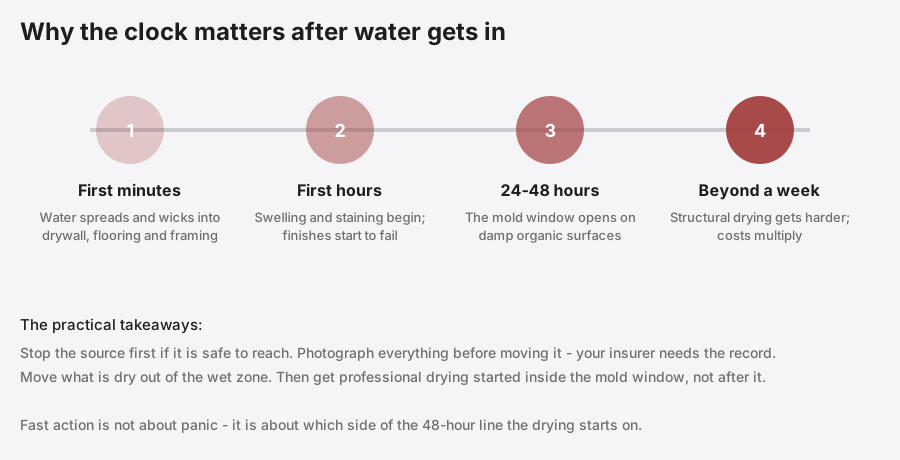
Water damage runs on a schedule that doesn't negotiate. In the first minutes, water wicks into drywall, flooring, and framing — spreading well past where it looks wet. Within hours, swelling and staining set in and finishes start failing. Somewhere in the 24-to-48-hour window, damp organic surfaces open the mold window. Past a week, structural drying gets genuinely difficult and costs multiply.
The practical translation for a homeowner: stop the source if it's safe to reach, photograph everything before touching it, move what's dry away from what's wet, and get professional drying started inside the mold window rather than after it. That's not panic — it's just knowing which side of the 48-hour line you want the work to start on.
And drying means measured drying. Surfaces lie; moisture meters don't. A floor that looks dry over a wet subfloor is the most expensive kind of finished job.
Here's the fact that surprises Lenoir County homeowners at the worst possible moment: standard homeowner's insurance covers sudden internal water — the burst pipe, the failed water heater — but not rising water from outside. Flood damage is a separate policy, written through the National Flood Insurance Program or a private flood carrier, and in a county the Neuse runs through, knowing which coverage you hold is worth checking today, on a calm afternoon, rather than discovering during a claim.
When a claim does happen, documentation decides it. Photos of damage before anything moves. The cause identified and recorded. Moisture readings at the start, during drying, and at completion. An itemized scope of what was removed, dried, and treated. Insurers pay provable claims; the homeowner's best friend in the process is a contractor whose paperwork makes the claim easy to prove. That documentation discipline is built into every job here, sudden pipe or rising river alike.
One more thing this county's history teaches: after every major water event, out-of-area crews follow the weather in. Some are legitimate; the pattern that isn't includes cash-up-front pressure, prices that exist only today, vague affiliations with agencies that don't do restoration work, and resistance to putting scope on paper. North Carolina doesn't license water restoration as its own trade, so your verification is the safety net: a certificate of insurance sent directly from the insurer, industry certification you can ask about and check, local references, and a written scope before work starts. Anyone organized enough to trust will clear that bar without friction.
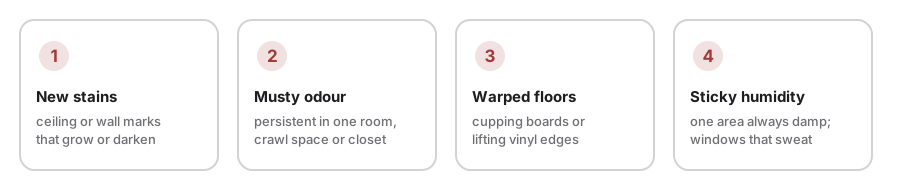
New stains, musty odor, warped floors, and stubborn humidity — in eastern Carolina's climate, quiet water announces itself if you know the signals.
The same discipline for a failed supply line on Queen Street and storm intrusion out toward Deep Run.
What's wet, how wet, and what the plan is — assessed, measured, and written down before the first fan runs.
Photos, moisture readings, and itemized scope from first walkthrough to final verification — your claim's evidence, built as we go.
Completion means moisture readings at dry standard, verified and recorded — not a surface that looks fine over a subfloor that isn't.
The floods get the headlines, but most of this county's water damage arrives quietly: the supply line that lets go behind the washer, the water heater that fails at year eleven, the roof that leaks into a wall cavity for a month before the stain shows, and the crawl space humidity that eastern Carolina serves all summer whether it rains or not.
Older Kinston housing stock carries particular exposure — original galvanized plumbing reaching end of life, additions with roof junctions that were never quite right, and vented crawl spaces breathing damp air under the floors all season. Quiet water is cheaper than flood water in every way except one: it gets more time to work before anyone notices.
The signals are learnable, and the four-sign diagram above covers most of them. When one shows up, a moisture assessment answers the question a nose and a guess can't — what's wet, how wet, and whether the problem is active or historical.
Based in Kinston and covering Lenoir County and its neighbors — La Grange and Pink Hill, Deep Run, up toward Grifton and Ayden, and the Greene and Jones County communities that share this stretch of the Neuse basin.
Near the county line? Call. Water doesn't respect the boundary and neither does the service area.
Seat of Lenoir County on the Neuse River, in the heart of eastern North Carolina.
Every water event in this climate carries a sequel option, and the 24-to-48-hour window decides whether it gets written. Damp drywall, wet subfloor, and soaked insulation are growth media; eastern Carolina's ambient humidity is the accelerant; and the difference between a drying job and a mold job is usually just the calendar.
That's why honest restoration treats the mold window as the deadline it is — and why remediation, when it's needed, starts with the moisture source rather than the visible growth. Killing what you can see while the leak or the crawl space keeps feeding what you can't is the cycle disreputable operators quietly rely on for repeat business.
Remediation done right is containment, removal of what can't be saved, treatment of what can, and moisture correction so the story actually ends. The mold page covers the details, including the honest line between a small cleanup a homeowner can handle and a job that needs containment.
Water on the floor right now, a stain that wasn't there last month, a musty room nobody can explain, or storm damage with a claim to document — call (555) 555-5555 and describe it. Clear plan, written scope, and a paper trail that protects you.
This county has seen what water can do at its worst. The point of good restoration is making sure your version of the story stays small.
Tell us what you need and we'll get back to you with a real answer. If it's an active backup or standing water over the field, calling gets you a faster response.
Call: (555) 555-5555
Area: Kinston, NC and Lenoir County
